
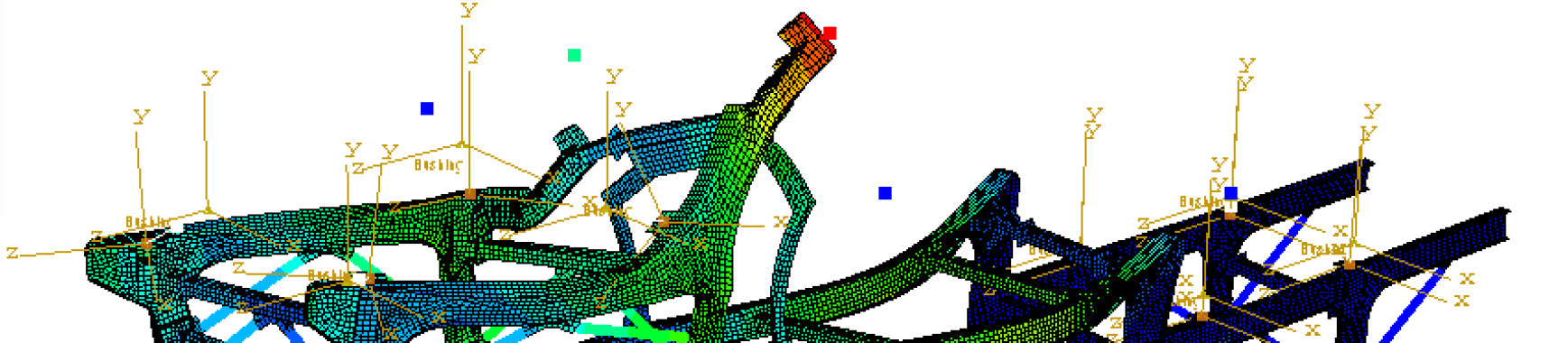
Finite Element Analysis (FEA) Consultants
FEA for vibration, fatigue, cracking and mechanical design validation — correlated to measurement where accuracy matters and supported through to verified engineering solutions.
Our proven process
Investigate → Test → Analyse → Design → Support
FEA is most valuable when it supports a real engineering decision: stop cracking, remove resonance, improve fatigue life, validate a design or prove a corrective solution. We use it within a practical process that starts with the problem and ends with evidence.
Investigate the problem context: symptoms, duty cycle, interfaces, constraints, failure history and acceptance criteria.
Test where uncertainty matters: vibration measurement, EMA/FRF/ODS, strain, operating data or pre/post comparison.
Analyse stress, stiffness, fatigue margin and dynamic response. FEA is used here to test design options and understand what is driving the behaviour.
Design the change: stiffness improvements, interface changes, damping, isolation, mounting strategy or practical detailing.
Support implementation and verification: reviews, iteration, pre/post overlays, evidence packs and close-out for acceptance.
In practice: measure → model → change → verify. That is the difference between a simulation report and a verified engineering solution.
Why choose us for FEA?
-
FEA that drives decisions, not just plots
We scope the analysis around the decision you need to make: remove resonance, stop cracking, improve fatigue life, verify a design margin, or demonstrate acceptance against defined criteria.
-
Closed-loop with measurement
In vibration and fatigue work, model accuracy depends on realistic boundary conditions, joints, supports, stiffness and excitation. Where outcomes depend on realism, we anchor models with measured behaviour using EMA / FRF / ODS so assumptions reflect the real structure.
-
Support through implementation and sign-off
The job is not complete when the model runs. We support design change, implementation and verification so the solution is proven by test or measurement and the project closes cleanly.
For what is FEA used?
Finite Element Analysis is a computer-based engineering method used to predict how a component, structure or mechanical system will behave under load, vibration, shock, temperature or operating duty. In practical projects, it helps identify stress, deflection, weak points, fatigue risks, natural frequencies and design changes before manufacture or modification.
For existing problems, FEA helps diagnose why a structure is cracking, vibrating excessively, failing qualification or behaving differently from expectation. It is especially powerful when combined with measured data to confirm excitation, transmission paths and structural amplification.
Vibration & resonance: natural frequencies, mode shapes, transmissibility, forced response and design separation.
Fatigue & cracking: hot spots, stress ranges, joint features, weld details and duty-cycle life prediction.
Design verification: stiffness, margins, deflection limits and pass/fail evidence to acceptance criteria.
FEA should answer a decision, not merely create a picture. The value comes from using the model to guide design action and then verifying the result.
What we do (FEA capability)
-
Core structural & dynamics analysis
Static stress/deflection, modal analysis, harmonic response and random vibration (PSD) with sensitivity, stiffness and margin studies.
-
Correlation & model updating (EMA ↔ FEA)
FRF and modal test data are used to inform boundary conditions, stiffness assumptions and selected properties so predictions align more closely with real behaviour.
-
Fatigue & durability
High-cycle fatigue, low-cycle fatigue, welded and bolted joints, notch sensitivity, stress concentration and duty-cycle assessment to reduce failure risk.
-
Design verification to acceptance criteria
Assessment against ISO, API, BS, qualification or client-defined requirements, with clear pass/fail thresholds and defensible assumptions.
Measurement integration: making FEA match reality
FEA can be misleading when the model is driven by assumptions rather than evidence. For vibration, fatigue and structural dynamics problems, measurement helps confirm what the structure is actually doing before design changes are committed.
FRF / modal testing to anchor boundary conditions and validate mode shapes and frequencies.
ODS to visualise operating deformation and identify amplification mechanisms.
Order tracking where speed-related excitations drive resonance risk.
Strain or vibration measurement where stress response, fatigue risk or operating behaviour needs confirmation.
Pre/post overlays to evidence improvement and support acceptance sign-off.
Standards & qualification
We support FEA and design verification where engineering evidence is needed for client acceptance, compliance, qualification, audit or technical close-out.
MIL-STD-810, RTCA DO-160, IEC 60068, API 619, ISO 20816 / ISO 7919 and project-specific acceptance criteria.
Test planning, instrumentation and execution with QA/QC and data lineage where required for audits and submissions.
Representative outcomes
API 619 compressor frame — stiffness re-engineering, resonance removed, compliance achieved.
Oil pan resonance — mode separation via FEA; durability improved.
Semiconductor plinth — VC-D micro-vibration performance verified.
Transport shock isolation — SRS-driven design protecting high-value assets.
Case Study Examples
If you tell us the asset type and symptom — cracking, resonance, compliance failure, excessive vibration or fatigue damage — we’ll point you to the closest relevant case study.
FAQs
How do you ensure FEA matches reality?
By correlating the model to measured FRFs, mode shapes, operating vibration, ODS or strain data where accuracy matters. This helps correct boundary conditions, stiffness assumptions and selected properties until the model is suitable for decision-making.
Do you handle redesign as well?
Yes — most projects include design changes to remove resonance, improve margins, reduce stress, improve fatigue life or meet acceptance criteria, with support through implementation and verification.
Will you support qualification testing?
Yes. We plan and run vibration, shock and environmental tests and provide compliance evidence for audits, technical submissions and client acceptance.
Is FEA always the right first step?
Not always. If the real excitation, boundary conditions or failure mechanism is unknown, measurement or investigation may be needed first. We advise on the right sequence so analysis is based on evidence rather than guesswork.
Discuss your project
Need to diagnose vibration, fatigue, cracking or design validation risk — and prove the fix? Speak with a Chartered engineer.
Return to Services